In the fast-paced world of texting and online chatting, acronyms have become a language of their own. One of the most commonly typed abbreviations is ASL.
People often wonder, “What does ASL mean in text?” This simple three-letter term has sparked curiosity among teenagers, Gen Z, and even adults navigating online conversations.
Understanding ASL can help you communicate clearly in casual chats, social media platforms, and even online dating.
In this guide, we will explore everything about ASL—from its meaning and origins to real-life usage, common misunderstandings, and trends in 2026—so you never have to feel confused when it pops up in a message.
1️⃣ Meaning & Definition
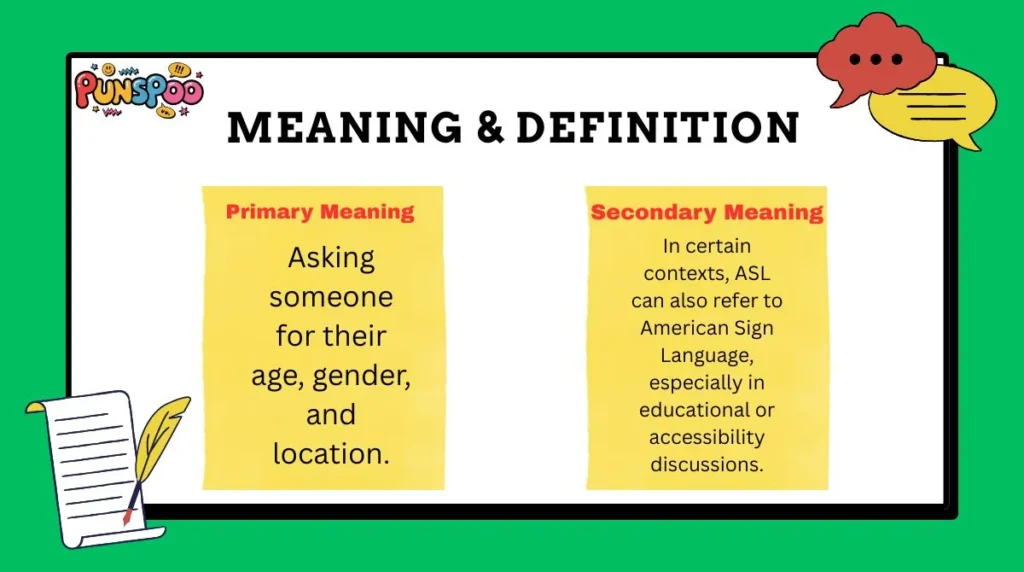
ASL is an acronym that primarily stands for Age, Sex, Location. It’s often used in online chats and social media to ask basic personal information in a concise way.
- Primary meaning: Asking someone for their age, gender, and location.
- Secondary meaning: In certain contexts, ASL can also refer to American Sign Language, especially in educational or accessibility discussions.
Real-life clarity:
If someone texts, “ASL?” in a chatroom or messenger, they are usually trying to know who you are in a quick, informal manner. It’s a shorthand way of getting acquainted without a long introduction.
2️⃣ Origin & Background of the Term
ASL originated in early internet chatrooms and AOL instant messaging in the 1990s. It became a staple of online communication when users wanted to quickly ask someone’s basic demographic information without typing full sentences.
- Slang roots: Casual, friendly shorthand for quick conversations.
- Technical roots: Not related to technology, but its efficiency mirrors early texting needs—brevity over formality.
The acronym has persisted for decades because of its simplicity and practicality.
3️⃣ What Does It Really Mean in Daily Life?
In daily texting or online chatting, ASL is more than just questions about age, sex, or location. It can convey curiosity, friendliness, or even flirtation.
- Friendship chats: Breaking the ice with strangers.
- Online communities: Quick way to categorize participants.
- Dating contexts: A casual intro before deeper conversations.
It’s a conversational tool that makes digital interactions smoother, faster, and often playful.
4️⃣ Usage in Different Contexts
Casual chatting:
- “Hey! ASL?” → A friendly way to ask someone’s basic info.
Professional/workplace:
- Rarely used; considered too informal. Better alternatives: “Could you share your basic details?”
Social media captions:
- “Throwback with my ASL crew 😎” → Here, ASL might be jokingly used to reference friends’ demographics.
Text messages:
- “ASL? 25/F/NYC” → Quick reply with age, sex, location.
5️⃣ Meaning Across Social Media Platforms 📱
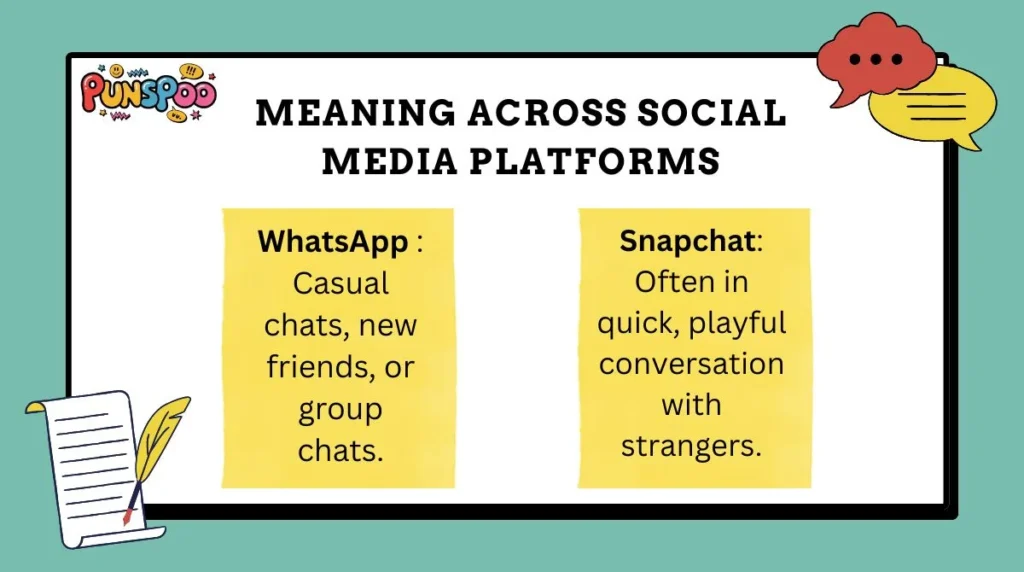
ASL usage can differ slightly depending on the platform:
- WhatsApp & Messenger: Casual chats, new friends, or group chats.
- Instagram & TikTok: Less common as DMs are visual, but still used in messaging.
- Snapchat: Often in quick, playful conversation with strangers.
6️⃣ Technical, Scientific & Other Meanings
Apart from texting:
| Field | Meaning |
|---|---|
| Education | American Sign Language |
| Aviation | Above Sea Level |
| Medicine | Arterial Spin Labeling (MRI technique) |
| Physics | Accelerated Stress Loading |
Context is key; the acronym can mean vastly different things outside casual texting.
7️⃣ Common Misunderstandings & Wrong Usage ❌
- Confusing ASL with American Sign Language when texting.
- Assuming ASL is rude or inappropriate—context matters.
- Misinterpreting it in professional settings; it can seem too casual or intrusive.
8️⃣ Similar Words & Alternatives
| Word | Meaning | Usage Difference |
|---|---|---|
| AMA | Ask Me Anything | Open-ended Q&A, not demographic info |
| DM | Direct Message | Private chat, not asking personal info |
| F/25/NY | Female, 25, New York | Specific answer format for ASL question |
| BRB | Be Right Back | Totally unrelated, casual shorthand |
9️⃣ Difference Between ASL & Similar Terms
Unlike AMA (Ask Me Anything), which invites broad conversation, ASL is specifically demographic-focused. DM is a private messaging feature, while ASL is a question asked inside a chat.
🔟 How to Use It in a Sentence
💬 “Hey, ASL?”
💬 “ASL? 22/M/Toronto 😄”
💬 “New here! ASL?”
💬 “ASL? Just curious 🙂”
1️⃣1️⃣ How to Reply When Someone Uses This Word
- Dating: “25/F/NYC, you?”
- Casual chat: “19/M/LA 😎”
- Playful reply: “Old enough to text you 😉”
1️⃣2️⃣ Meaning in Online Dating & Social Conversations ❤️
For Gen Z and millennials, ASL isn’t just a question—it’s a fun, quick way to start a conversation. It can be flirty, friendly, or a simple curiosity check.
1️⃣3️⃣ Popularity & Trend Over Time 📈
- Early 2000s: Peak usage in chatrooms.
- 2010s: Declined in mainstream texting, still popular among online communities.
- 2026: Revived in memes, social media quizzes, and retro internet culture trends.
1️⃣4️⃣ Why This Word Is Trending in 2026
ASL has seen a comeback due to nostalgia, social media memes, and retro chat apps. Short, quick, and slightly mysterious, it resonates with today’s fast-scrolling audiences.
1️⃣5️⃣ Pros & Cons of Using This Term
Pros:
- Quick & concise
- Icebreaker in casual conversations
- Retro charm
Cons:
- Can seem intrusive
- Misunderstood in professional settings
- Not suitable for long-form introductions
FAQs
Q1: Is ASL rude to ask?
A: Not usually, but context matters—use with friends or casual chats.
Q2: Can ASL mean American Sign Language?
A: Yes, especially in educational or accessibility contexts.
Q3: How do I reply to ASL?
A: Simply share your age, sex, and location, e.g., “22/F/NY.”
Q4: Is ASL still used in 2026?
A: Yes, mainly in social media chats and dating apps.
Q5: What’s the difference between ASL and AMA?
A: ASL asks for personal demographics; AMA invites open conversation.
Conclusion
ASL is a small acronym with a big role in online communication.
Whether you encounter it in text messages, social media, or dating apps, knowing its meaning and proper use ensures smooth, friendly, and even playful interactions.
While its roots trace back to 90s chatrooms, ASL has evolved with online culture, adapting to new trends while maintaining its simplicity.
Understanding ASL is more than decoding letters—it’s a window into the way digital generations communicate today.

“I’m Maria James, weaving playful word-magic into every pun I craft at PunsPoo. I love turning language upside down and making you smile one clever twist at a time.”