In today’s fast-paced digital world, texts are more than just words—they carry hidden emotions, intentions, and meanings.
“Decoding meaning in text” refers to understanding what someone truly means behind their messages. People search for this term because misreading texts can cause confusion, misunderstandings, or even social drama.
Whether it’s a casual chat with friends, a workplace message, or an online conversation, interpreting text accurately has become a vital skill.
In this article, we’ll explore everything about decoding text meaning, its origins, real-life applications, and tips for reading between the lines.
By the end, you’ll be able to decode texts like a pro and avoid common misinterpretations.
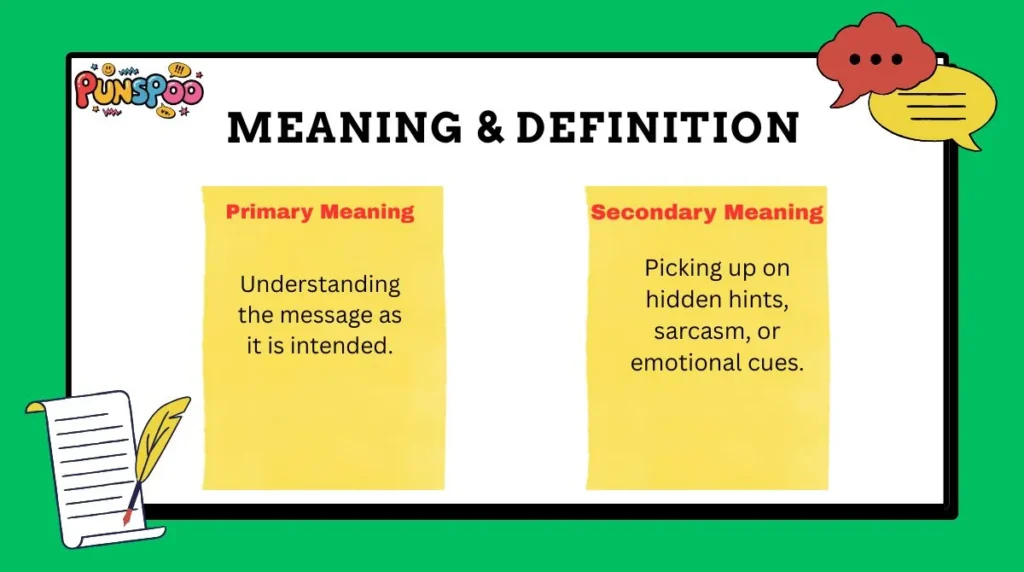
1️⃣ Meaning & Definition
Exact Meaning: Decoding meaning in text is the process of interpreting the intended message, tone, or emotion behind written words.
Simple Words: It’s figuring out what someone really means when they write something, not just reading the words.
Primary Meaning: Understanding the message as it is intended.
Secondary Meaning: Picking up on hidden hints, sarcasm, or emotional cues.
Real-life clarity:
- Text: “Sure, whatever 🤷”
- Decoded meaning: The person might be annoyed or dismissive, not genuinely agreeing.
2️⃣ Origin & Background of the Term
The concept of “decoding text” comes from linguistics and communication studies. Early research in the 20th century focused on how written communication conveys meaning without voice tone or body language. In modern times, with texting, instant messaging, and social media, the need to decode text meaning has become everyday knowledge. Some of the slang forms used online, emojis, and abbreviations add layers that make decoding necessary.
3️⃣ What Does It Really Mean in Daily Life?
In daily life, decoding meaning helps you:
- Avoid misunderstandings with friends or coworkers
- Understand sarcasm, humor, or hidden frustration
- Gauge tone in professional emails
Example:
- Text: “I’ll try to make it…”
- Real-life decoding: The person probably isn’t fully committed but is being polite.
Decoding meaning adds empathy to communication, letting you understand others beyond the words.
4️⃣ Usage in Different Contexts
Casual chatting: “k” → Could mean okay, annoyed, or lazy reply.
Professional/workplace: “Let’s circle back” → Usually means “We won’t address it now.”
Social media captions: “Feeling blessed 🙏” → Shows gratitude or positivity, often with social signaling.
Text messages: “LOL” → Literal laugh or just to fill awkward silence.
5️⃣ Meaning Across Social Media Platforms 📱
- WhatsApp: Informal, often includes shorthand and emojis.
- Instagram: Often highlights personality through captions; emoji-heavy.
- TikTok: Short, playful, or trending phrases; humor is key.
- Snapchat: Quick, casual messages with emojis/stickers; sometimes ephemeral.
Each platform influences how meaning is sent and interpreted.
6️⃣ Technical, Scientific & Other Meanings
Outside casual use, decoding has formal meanings:
- Computer Science: Decoding data from one format to another.
- Medical: Decoding DNA or genetic sequences.
- Aviation/Navigation: Decoding signals for flight communication.
- Cryptography: Decoding secret messages or ciphers.
So, the term isn’t just social—it has scientific and technical roots.
7️⃣ Common Misunderstandings & Wrong Usage ❌
- Thinking “LOL” always means laughter.
- Misinterpreting sarcasm as sincerity.
- Reading tone too harshly without context.
Tip: Always consider emojis, punctuation, and relationship context.
8️⃣ Similar Words & Alternatives
| Word/Phrase | Meaning | Difference from “Decoding Meaning” |
|---|---|---|
| Interpreting | Explaining words in your own way | Broader, may not include tone |
| Understanding | Grasping content fully | Less focus on hidden hints |
| Reading between lines | Detecting hidden or implied meaning | Informal, emotional emphasis |
| Analyzing | Breaking down text logically | More formal, less emotional |
| Translating | Converting text to another form/language | Technical focus |
9️⃣ Difference Between “Decoding Meaning” & Similar Terms
- Decoding: Focus on intent & hidden messages.
- Understanding: Focus on literal content.
- Interpreting: Subjective explanation, may vary by reader.
🔟 How to Use It in a Sentence (Chat-Style Examples)
💬 Example 1: “I didn’t text back because I was busy 😅” → Decoding: They weren’t ignoring you.
💬 Example 2: “k” → Could mean irritation or casual agreement.
💬 Example 3: “We’ll see 🤔” → Decoding: Unlikely to happen.
💬 Example 4: “LOL” → Could be nervous laughter or genuine humor.
1️⃣1️⃣ How to Reply When Someone Uses This Word
- Casual: “Haha, got it 😆”
- Dating: “Oh, interesting… tell me more ❤️”
- Workplace: “Understood, thanks for clarifying.”
1️⃣2️⃣ Meaning in Online Dating & Social Conversations ❤️
In dating chats, decoding meaning is crucial to spot interest, sarcasm, or hesitation. Emojis often carry emotional weight:
- “😂” = playful, joking
- “😉” = flirty, teasing
- “🙂” = polite, neutral
1️⃣3️⃣ Popularity & Trend Over Time 📈
“Decoding meaning in text” has grown with texting apps and social media. Google Trends show spikes during social media booms and new app releases, especially with Gen Z and Millennials.
1️⃣4️⃣ Why This Word Is Trending in 2026
People want clarity in digital communication. Memes, AI chatbots, and texting culture require better understanding of subtext, tone, and hidden meanings.
1️⃣5️⃣ Pros & Cons of Using This Term
Pros:
- Helps avoid misunderstandings
- Improves social intelligence
- Enhances digital communication
Cons:
- Overthinking texts can create anxiety
- Misinterpretation still possible
- Can read too much into emojis
FAQs
Q1: Is decoding meaning in text only about emojis?
A: No, it includes tone, punctuation, phrasing, and context.
Q2: Can decoding help in professional emails?
A: Yes, it prevents misreading polite or indirect communication.
Q3: Is “k” always negative?
A: Not always; it depends on tone and context.
Q4: Does decoding mean reading between the lines?
A: Often yes, but also understanding literal meaning.
Q5: Can AI help decode text meaning?
A: Yes, AI can analyze tone and context but human judgment is key.
Conclusion
Decoding meaning in text is a vital skill in today’s digital world.
From casual chats to professional emails and online dating, understanding the tone, intention, and hidden emotions behind messages helps avoid confusion and miscommunication.
While emojis, shorthand, and online trends can complicate text interpretation, practicing decoding can enhance your social intelligence and empathy.
As texting and social media continue to evolve in 2026, mastering this skill will make your digital communication smoother, clearer, and more connected.
So next time you read a message, pause, decode, and respond with confidence!

“I’m Maria James, weaving playful word-magic into every pun I craft at PunsPoo. I love turning language upside down and making you smile one clever twist at a time.”